Date Clock
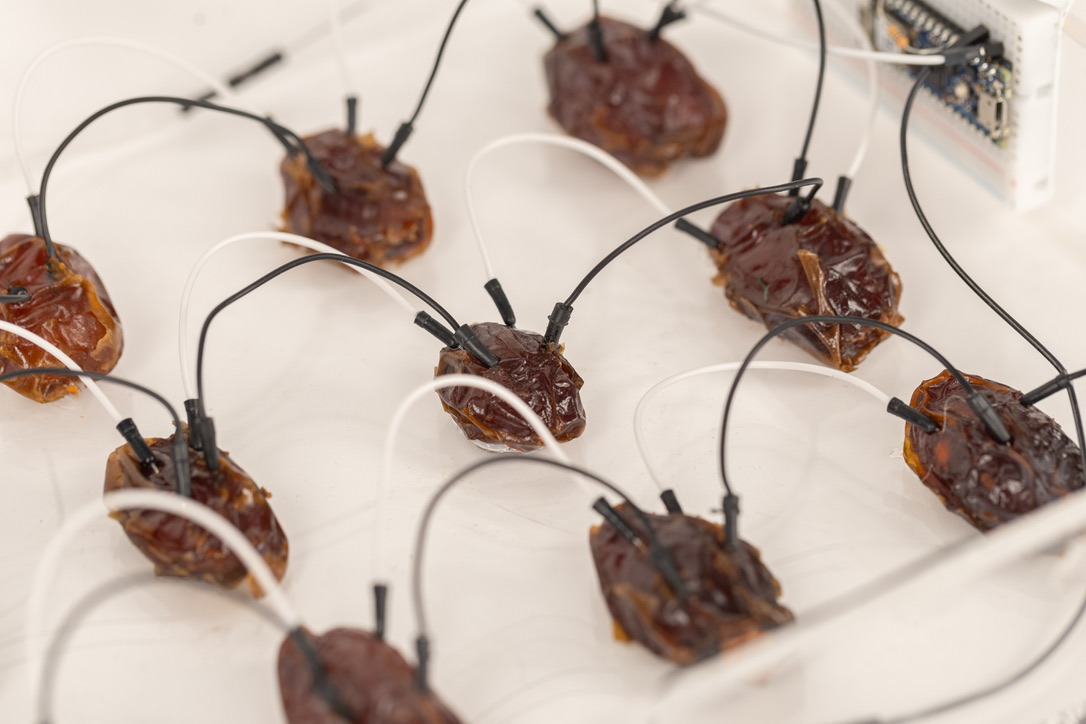
A clock made of dates. As the fruit dries out, its conductivity changes, and that changes the value on the clock.
- Problem
- Digital clocks give more precision than most decisions need — a countdown to the second for things that matter by the day.
- Response
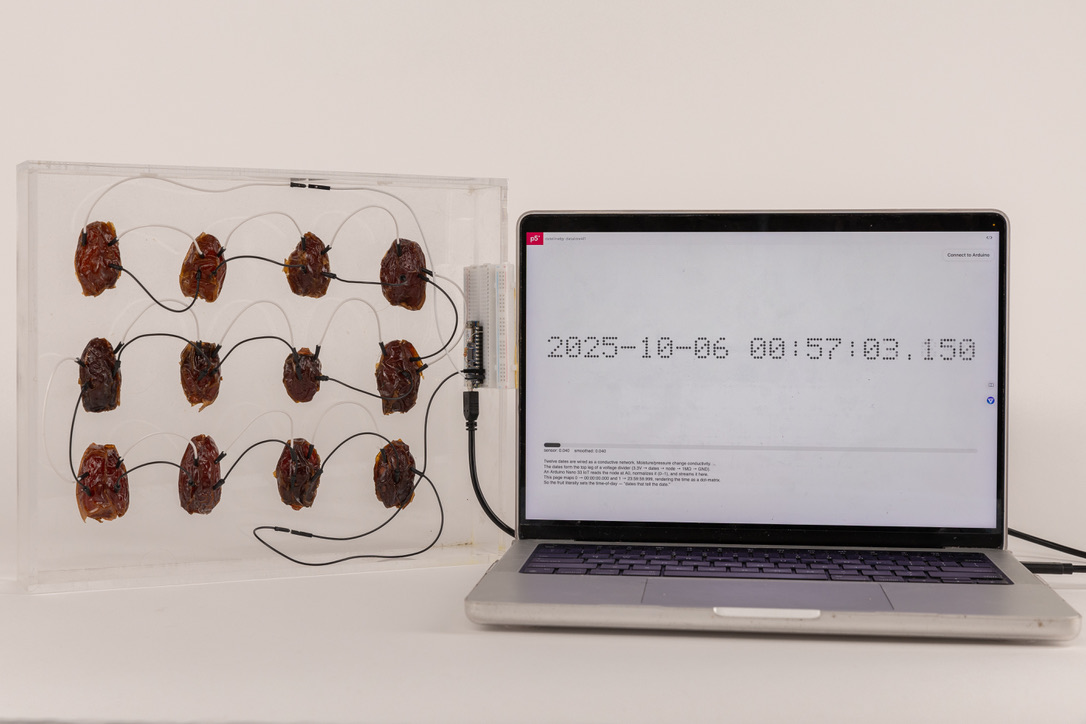
- A clock made of twelve dates. As the fruit dries out its conductivity changes, and that moves the time on the clock.
- Outcome
- Within a day or two, testers had their own rough sense of early, midway, and spent, with nothing labelled.
The Problem
Digital clocks give more precision than most decisions need. You get a countdown to the second for something that only matters by the day or the week. I wanted to make a timepiece that was openly imprecise, and find out whether people would still trust it, or even prefer it.
The Approach
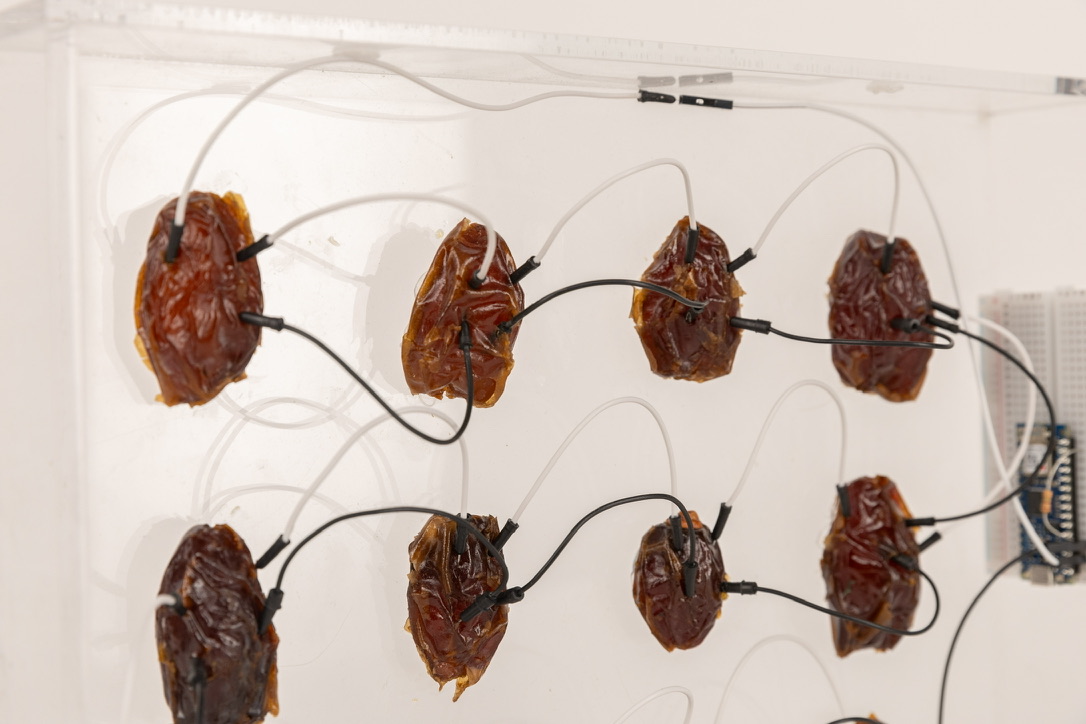
I attached twelve dates to an acrylic box in a 3 x 4 grid with hot glue, and wired them in serial to an Arduino Nano IoT 33 on a breadboard. The dates act as one half of a voltage divider, with a 1M ohm resistor as the other half. The positive side runs to the 3.3v pin and the negative side runs through the resistor on A0/D14 to ground. The Arduino reads the node voltage and normalizes it between 0 and 1, where 0 is 0v and 1 is 3.3v. In p5.js that value is smoothed and mapped to a time of day, multiplied against the 86,400,000 milliseconds in a day. As the dates lose salt, minerals, and water, their conductivity changes, and the node voltage changes with it. There is nothing to read at a glance. The state of the object is the interface, so you build a sense of it over time rather than parsing a number.
It is not a precise way of keeping time. The node voltage does not change linearly, and while a fresher date is generally more conductive than an older one, the relationship is loose enough that it responds to the dates more than it reports the hour. I may refine it if I find a way to make it track the passage of time more reliably. In the meantime I think it works as a way to observe the relationship between time and rotting fruit.
What I Learned
People learned to read it faster than I expected. After a day or two, testers had their own rough sense of early, midway, and spent, without my having labelled anything. It changed how I think about legibility. Precision and usability are not the same thing, and a rougher signal that you have to get familiar with can produce a stronger relationship with an object than a screen does.